


Review by Maisie Chan | Originally published in the print edition, April 24th 2026
Screen printing is precise, and he wants to find a way to be imprecise. He washes the
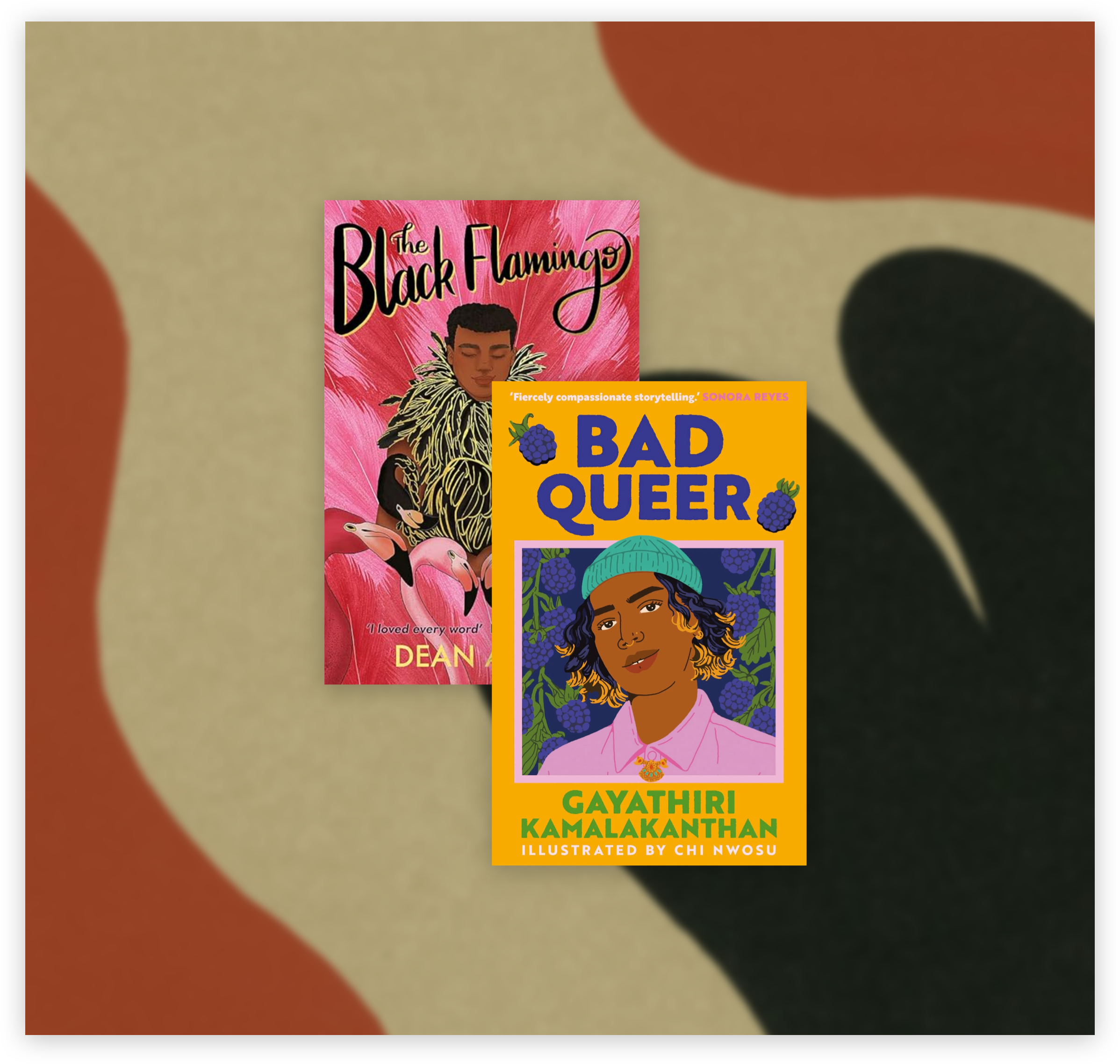
Dean Atta’s The Black Flamingo and Gayathiri Kamalakanthan’s Bad Queer are powerful verse novels that are poignant, honest and hard to put down. Both offer safe havens for gay, queer, trans or questioning youth, especially young people of colour who exist in multiple spaces.
We follow protagonists, Michael and Surya, as they navigate aspects of their own multifaceted identities in a world that does not always accommodate or understand them. When The Black Flamingo by Dean Atta was published in 2019, it was a seminal British YA novel that did not shy away from exploring the intersections of race, sexuality and gender. Although written and published at different times, both books are on a continuum. Kamalakanthan notes in their acknowledgements how Atta’s novel was an inspiration in their own work. It is evident in the confident storytelling in Bad Queer that Atta’s novel had opened a space where gay, trans and queer voices could become part of conversations in the YA space. Both books baulk the neat boxes of representation that publishing often likes to slot YA titles into and the form of the verse novel adds to this resistance.
“Each examine how our parents or grandparents can shape us, by their presence, curt words, or by their absence”
Generally, YA novels have a short time frame, focusing on the teen years. However, Atta’s debut novel follows Michael, the protagonist, over a longer period – from infant school to university. Conversely, in Bad Queer, Surya, the main character, is in their last year of sixth form. Similar themes are shared in both books: such the desire for freedom, teen crushes, and finding safe spaces whilst existing in a world that sees and enforces binaries.
Race and cultural heritage also feature in both novels as Michael navigates more of his identities – being Greek Cypriot and Jamaican. His dad is not in his life, but his uncle is. Surya’s Sri Lankan Tamil roots feature in the relationship they have with their grandparents, who did not speak to Surya’s mother for a long time.
Beginning The Black Flamingo with six-year-old Michael allows the reader to see the innocence and confusion as he confides in us that he did not want the Teenage Mutant Ninja Turtle toy from his mum. He coveted the Barbie instead. Michael’s mum is hesitant, she is worried what others might think. Family dynamics are prevalent in the two novels as each examine how our parents or grandparents can shape us, by their presence, curt words, or by their absence. When Michael loses his new jacket; his mum calls him a “stupid boy”; then slaps him across the face, an interaction that jolts the reader. We are told she is “doing her best”; yet feel for a child who in that moment is very much alone and hurting.
In contrast, in Bad Queer, Surya’s confidence in their non-binary identity within their immediate family is obvious from the start. Surya’s parents are kind and supportive of their queer child because they themselves are queer. Surya is an unapologetic non-binary character. They know who they are. Unlike young Michael, Surya has solid parental role models and the opening Prologue declares:
I am not a girl
But the idea of being a girl
Is everywhere
I can’t escape it
except
when I’m home with Ammā and Mum.
The reader is told Ammā is genderfluid and at home, Surya can be themselves.
Surya tells us that in their home:
Together, we build our own cocoon,
a home filled with music and dance,
a place to practise our freedom
However, Atta’s Prologue opens with an acknowledgement of difference, a single bird alone looking within. These observations bring humour and sadness.
I am the black flamingo
The black flamingo is me
Trying to find myself
Performance becomes an important pastime for both main characters, Michael joins the Drag Society and Surya, a youth theatre. Performance can be seen as a metaphor, are we all just performing roles and genders? Are there spaces we can truly be ourselves in?
Surya’s identity is not in question, rather, the novel is about navigating spaces as well as first love and romance. Will the boy that Surya has a crush on like them back for who they really are? Bad Queer is a romance, a book about first kisses, and how far to go. Although first crushes appear in The Black Flamingo, the focus is on transformation. The Black Flamingo is a story about a Black queer boy turning into a Black queer man.
These verse novels do an incredible job of weaving details of their protagonist’s heritage with their circumstances, creating a tapestry of colourful experiences and personality. They do not bow to pressure to fit into one box or another. Both books offer safe havens for young people of colour searching for welcoming queer spaces in young adult literature.
Maisie Chan is a multi-award-winning author. She won the Jhalak Prize and Branford Boase with her debut children’s novel Danny Chung Does Not Do Maths.