


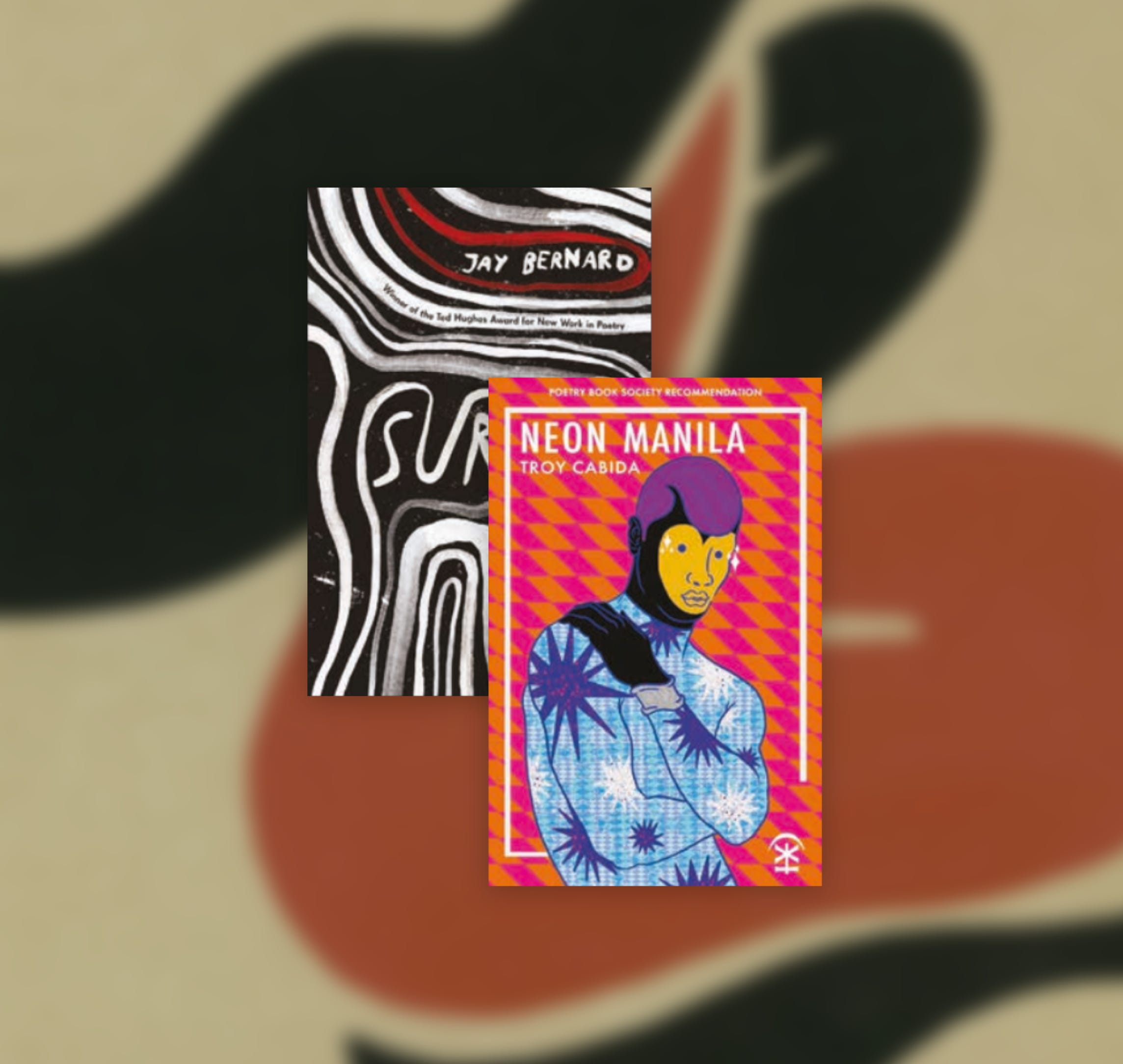
Review by Denise Saul | Originally published in the print edition, April 24th 2026
Jay Bernard’s Surge and Troy Cabida’s Neon Manila reflect the broader historical and political shifts of migration and identity politics. Rather than resolving the tensions between belonging and representation, both poets incorporate the complexities of negotiation and redefinition of the self into their lyricism with content and form. In the process of destabilising modes of poetic practice, fractures and contradictions are exposed. Bernard and Cabida create moments which are transformative and yet, disruptive. Both collections challenge language shaped by cultural and racial assumptions in their refusal of reductive frameworks to define the self in singular or static terms.
Surge intertwines poetry and archival material to navigate through the past and present of Black British history. Centred in recordings, interviews and visual images, the collection embraces the stories of two fires, Grenfell of 2017 and New Cross of 1981. At the start of Surge, Bernard’s speaker recalls the aftermath of the New Cross Fire of 1981 dubbed the ‘New Cross Massacre: “remember we were brought here from the clear waters of our dreams/ that we might be named, numbered and forgotten”. The statement refers to the porous borders of identity, race and geography in the era of Thatcher’s England. Stylistically Bernard’s oeuvre redefines the self as an overlaying of multiple shifting identities located in contemporary spaces.
The poems are an archival response to the ‘near silence from the government and the press’ of both events. In the author’s note, Bernard writes: ‘I am from here, I am specific to this place, I am haunted by this history but I also haunt it back’. What follows is a resurrection of voices or a sort of clamouring to be heard. In ‘Ha-my-ca’ the speaker of the poem mentions: ‘I might have learned a word for my body, not felt so alone later’. The ‘I’ becomes the voice of many within the sequence of poems. Bernard weaves these voices together and in the archiving process allows voices from the community to speak on their own terms.
“Tuning insightfully into personal and collective grief, Surge operates as poetry of witness, recording the marginalisation of black communities in Britain”
Tuning insightfully into personal and collective grief, Surge operates as poetry of witness, recording the marginalisation of black communities in Britain. The poem ‘Pace’ is an example of the complex identity emerging through language and a shared history of displacement: ‘I have seen the light you’ve seen/ and my body has been where yours has been/some part of me resides where you reside/we’ve swapped presences and parting-.’ As events are recorded and remembered by various witnesses, we are drawn into various stages of collective and personal grief:
how do we ask the quiet you’ve left
what voice you recalled
whose hand you were holding?
In similar ways to Bernard, Cabida is conscious of how poetry can unpack what it means to belong to a culture that marginalises the queer self. In a post-pandemic and post-Brexit landscape, Neon Manila continues to grapple with processes of negotiation and redefinition. Aspects of the body continue to function as a crucial literary site, through which questions of belonging and visibility are explored. Cabida’s preference for world-building is evident but what is interesting to note is how often poetry is rooted in culture, pop music and fashion. Representation resounds in specificity of designer names and pop culture. The way the world is interpreted around Cabida is through a refusal to comply with singular or static terms for personal narratives. Arranged in three sections, the first of which, ‘Thalassophobia’ is stylistically varied in lineation and form. The contemporary sonnet: ‘Order No: #UK65388’ performs the work of co-sharing multiple layers of being as a controlled experience through fashion or dressing up. Here, aspects of the selfhood are reduced to items of clothing: ‘jacket and trouser in biscuit, roll neck, canary, caramel shades’ and through them the speaker: ‘controls how much is seen, what can be accessed’. The tension between the act of dressing up and cultural history populates the sequence of poems as different versions of the self are offered. Cabida demonstrates how vividly the poetic narrative can operate as a vehicle for expressing the relationship between Filipino brown body and desire.
“Cabida’s preference for world-building is evident but what is interesting to note is how often poetry is rooted in culture, pop music and fashion”
Exploring the gap between self-image and how one is seen through fashion presentation, the poems offer an expansive inner journey from youth to adulthood.
The poem ‘You walked into school wearing your mother’s heels’, confronts head on the experiences of shame and guilt that existing in a hostile environment might exacerbate. The speaker recognises the places of familiar exclusivity where bodies are forced to shift and re-invent themselves:
You walked past the kids, the teachers,
your cousin who ended up bullying you,
their heads like fluorescent bulbs
glowing with hate…
Though Bernard’s and Cabida’s approaches are dissimilar, both poets draw on the transformative power of belonging to reground or redefine the marginalised body.
Denise Saul is a poet and fiction writer.